

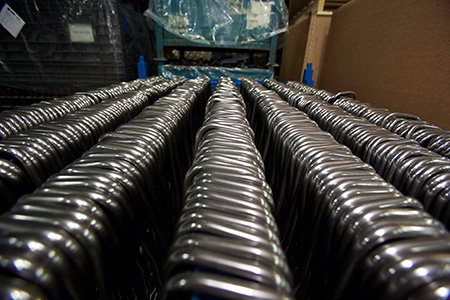
 Burnishing is a metal-finishing process used to improve the surface quality, dimensional accuracy, and appearance of metal components. Unlike many conventional machining processes that remove material by cutting, burnishing mainly deforms and smooths the surface by pressing a hard, polished tool against it. The process is widely used in manufacturing because it can produce a smooth, shiny, and work-hardened surface while maintaining close dimensional tolerances.
The basic principle of burnishing is relatively simple. A hard tool, usually made from hardened steel, carbide, or a similar wear-resistant material, is pressed against the surface of a metal workpiece. The tool may be a ball, roller, or specially shaped burnishing element. As the workpiece or tool moves, the applied pressure causes the small peaks and irregularities on the metal surface to flow plastically into the valleys. This produces a more uniform and smoother surface without significantly changing the overall shape of the component.
There are several types of burnishing used in metal finishing. Roller burnishing uses one or more hardened rollers that are pressed against the workpiece. It is commonly used for cylindrical components such as shafts, pins, and hydraulic components. Ball burnishing uses a hardened ball that contacts the surface under pressure and is particularly useful for producing very smooth internal or external surfaces. Other specialized methods include diamond burnishing, which uses a diamond-tipped tool to achieve extremely fine surface finishes, and tool burnishing, which is adapted to particular shapes and manufacturing requirements.
Burnishing can be performed on different types of metals, including steel, stainless steel, aluminum, copper, and certain alloys. The choice of burnishing method depends on the material properties, component geometry, required surface finish, and production requirements. Softer metals generally require lower forces, while harder materials may require greater pressure and carefully selected tooling.
One of the main purposes of burnishing is to reduce surface roughness. Machining operations such as turning, milling, and grinding can leave microscopic peaks, grooves, and tool marks on a component. Burnishing smooths these irregularities and can produce a highly polished surface. This is particularly important for components that must move against another surface, such as shafts, bearings, hydraulic cylinders, and precision mechanical parts.
Another important benefit is improved wear resistance. During burnishing, the surface layer of the metal is plastically deformed and becomes harder through work hardening. This hardened surface can provide better resistance to wear and deformation during service. Burnishing can also improve fatigue strength because it introduces compressive residual stresses into the surface. These stresses can help reduce the tendency of cracks to initiate and propagate under repeated loading.
Burnishing can also improve the dimensional accuracy of manufactured components. When carefully controlled, the process can remove small surface irregularities and bring a component closer to its required dimensions. However, burnishing should not be considered a replacement for major material-removal operations. It is generally used as a finishing operation after machining, when only a small amount of surface correction is required.
The process also has economic advantages. Because burnishing can produce a high-quality surface relatively quickly, it may reduce the need for additional grinding or polishing operations. It can therefore lower production time and tooling costs in suitable applications. In mass production, burnishing tools can be incorporated into automated machinery, making the process efficient and repeatable.
However, successful burnishing requires proper control of factors such as tool pressure, feed rate, speed, lubrication, and the initial surface condition of the workpiece. Excessive pressure can cause unwanted deformation or dimensional changes, while insufficient pressure may fail to produce the desired finish. Lubrication is often used to reduce friction and prevent damage to both the tool and workpiece.
In conclusion, burnishing is an important metal-finishing technique that improves a component primarily through controlled plastic deformation rather than material removal. It produces smoother surfaces, can increase surface hardness and wear resistance, and may improve fatigue performance and dimensional quality. Because of these advantages, burnishing is commonly used for precision components in industries such as automotive, aerospace, hydraulic equipment, and general engineering. When correctly controlled, it provides an efficient way of achieving high-quality metal surfaces after conventional machining operations.